

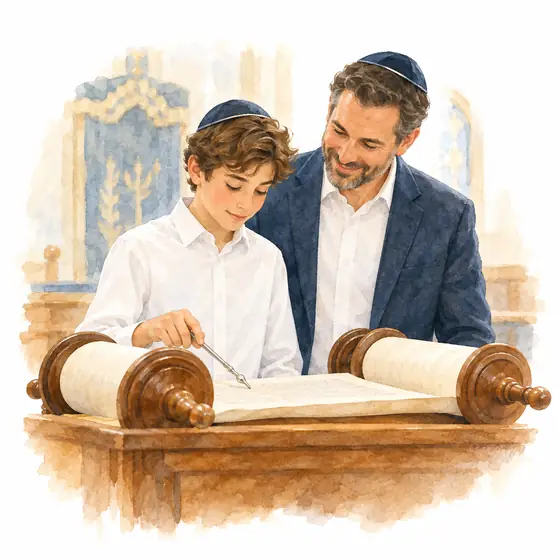

He has practiced the blessings at the kitchen table. Someone has checked his shirt. Now he stands before the Torah, and the voice his family knows so well suddenly sounds a little different.
A bar mitzvah marks a boy’s growing responsibility within Jewish life. The celebration may fill a hall or fit around a family table. Its meaning begins before the guests arrive.
What changes at thirteen?
Bar mitzvah means “son of the commandment.” Traditionally, a Jewish boy reaches this milestone on his thirteenth Hebrew birthday and becomes personally responsible for observing the mitzvot, the religious commandments.
He reaches that status whether or not there is a ceremony. Reading perfectly, giving a speech, and hosting a party do not create it. Nor does he suddenly stop needing his parents. This is religious responsibility, with plenty of growing still ahead.
Where did the tradition begin?
Jewish legal tradition connects thirteen with religious maturity. The Torah does not set out the familiar bar mitzvah celebration as a single ceremony.
Its familiar elements developed over time: taking a public role in prayer, receiving an honor at the Torah reading, sharing learning, and celebrating with a meal. The old idea is responsibility; each generation has found ways to make that new beginning visible.
Preparing for the day
A teacher helps the boy learn the blessings and understand what he will do in his synagogue. Some boys prepare a Torah reading, a haftarah from the Prophets, or a short teaching called a d’var Torah. Receiving an aliyah—the honor of reciting the Torah blessings—is not the same as chanting the whole weekly portion.
Tefillin, the small leather boxes containing passages of Torah, are another important part of traditional preparation. They are worn for weekday morning prayer, not on Shabbat or the major festivals. Families follow their community’s practice about when to begin learning to put them on.
Ashkenazi and Sephardic celebrations
The Torah melodies, pronunciation, and family songs may sound different in Ashkenazi and Sephardic synagogues. The prayer shawl, or tallit, has its own customs. Many Sephardic and Western Ashkenazi boys begin wearing the large tallit by bar mitzvah age or earlier. Many Eastern European Ashkenazi families wait until marriage.
Some communities greet the boy with sweets after his Torah honor. Others mark the occasion with a particular melody, a family blessing, or a lively gathering. These are community customs, rather than one worldwide script.
Jerusalem, a local synagogue, or a family table
Some Israeli families and visitors celebrate at the Kotel, Jerusalem’s Western Wall. A weekday ceremony can include tefillin and an aliyah, with relatives sharing honors and songs. At the main Orthodox prayer plaza, men and women participate from their respective prayer sections.
Elsewhere, a familiar neighborhood synagogue may be the most meaningful place. A meal afterward gives the boy a chance to share a thought of his own. The family does not need a destination event to give the day depth.
Kabbalah, blessings, and segulot
The Zohar, a central work of Kabbalah, connects thirteen with a new stage of spiritual life. Its language describes the soul’s growth and a deeper relationship with God. This is a mystical understanding of the milestone, alongside its legal meaning.
Some families also ask about segulot, practices associated with spiritual blessing. It helps to distinguish these from mitzvot and community customs. Chabad birthday practice encourages extra charity, prayer, Torah study, and a positive commitment for the coming year. These are meaningful ways to mark the day, rather than a prescribed set of bar mitzvah segulot.
Learning a passage with a grandfather, giving quietly to someone in need, or choosing a mitzvah to keep practicing can make the meaning personal. In these traditions, spiritual blessing is connected with faith and action, rather than a guaranteed result.
A small keepsake for the years ahead
Choose something he would enjoy wearing: a Chai necklace or a small turquoise Star of David. Add a few handwritten words about the person you see him becoming. Those may be the part he keeps longest.
For a girl’s coming of age, explore our separate story about bat mitzvah traditions.
© Sarel Jewelry. All rights reserved. Please share this article by linking to the original page on sareljewelry.com. Copying or republishing our original text without prior written permission is prohibited, except as permitted by law.