

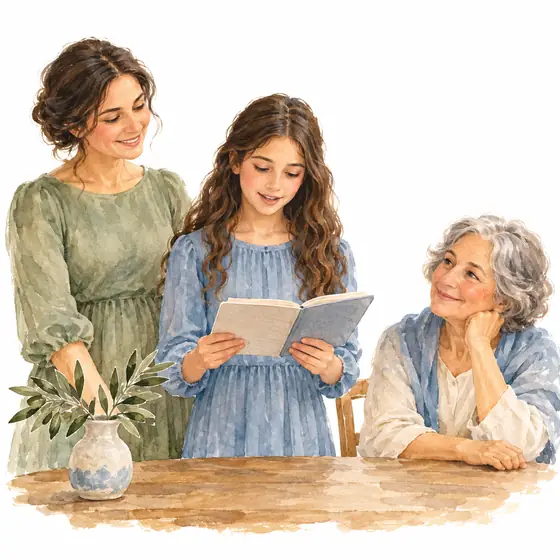

A girl stands up to share something she has learned. Her family listens, perhaps with a few more tears than she expected. For a moment, the room belongs to her voice.
A bat mitzvah celebrates a new stage of Jewish responsibility. Some girls mark it in synagogue, others with study, a family meal, or a gathering of women and friends. Each celebration can make room for the girl herself.
Twelve or thirteen?
Bat mitzvah means “daughter of the commandment.” In traditional Jewish law, the milestone comes at twelve, counted by the Hebrew calendar. Many Reform and Conservative congregations hold the public celebration at thirteen. The family’s rabbi or synagogue can explain the practice they follow.
A girl does not need a party to acquire her religious responsibilities. The celebration recognizes a change; it does not create it. She is also still a young person who needs encouragement, patience, and adults who listen.
An old milestone, a changing celebration
Jewish teaching about a girl’s religious maturity is much older than today’s familiar bat mitzvah events. The public ways of celebrating that maturity developed differently across communities.
In nineteenth-century Baghdad, Rabbi Yosef Hayyim, known as the Ben Ish Hai, encouraged marking the day with joy and special clothing. Celebrations for girls were also known in nineteenth-century Italy.
A widely remembered American milestone came in New York in 1922, when Judith Kaplan celebrated in a public synagogue ceremony. Earlier celebrations had taken place elsewhere, and her own ceremony differed from the Torah-reading roles many girls take today. The tradition has more than one beginning.
What does she prepare?
Preparation can include learning prayers, exploring Jewish texts, writing a short teaching, and choosing a charitable project. The aim is understanding and participation, with a role suited to her community and abilities.
A good starting question is wonderfully simple: “What would you like to learn?” One girl may want to explore a biblical woman; another may be drawn to Jewish music, family history, or a mitzvah she can put into practice.
Different communities, different voices
In many Orthodox families, a bat mitzvah is celebrated through a Torah teaching and a meal at home or in a community setting. Girls and women may learn or sing together. Some celebrations include challah baking; the religious act of separating dough has its own requirements, so a knowledgeable teacher guides it.
Sephardic families have their own traditions of blessings, festive dress, and family hospitality. The Ben Ish Hai’s encouragement is one historical example, not a single ceremony shared by every Sephardic community.
In many Reform and Conservative congregations, the girl receives an aliyah, the honor of reciting the Torah blessings. She may also chant from the Torah, read a haftarah from the Prophets, or help lead the service. The details depend on the congregation. Each community gives the milestone its own shape.
Kabbalistic meaning and segulot
In Hasidic teaching, a mitzvah gives a spiritual purpose a place in everyday life: generosity becomes a donation, learning becomes a choice, and a family tradition becomes something she can make her own. That makes this birthday a beginning worth paying attention to.
Families sometimes ask about segulot, practices associated with spiritual blessing. These should be distinguished from mitzvot and community customs. Chabad birthday practice, for example, encourages extra charity, prayer, Psalms, and a positive commitment for the coming year. It regards the birthday as a time of spiritual opportunity, rather than prescribing a special set of bat mitzvah segulot.
Shabbat candles or a challah workshop may be meaningful activities in some homes. She may have practiced these mitzvot since childhood; now she can explore their meaning more deeply. These acts express faith and intention, without promising a particular outcome.
Let the celebration feel like her
A family meal, favorite songs, a grandmother’s story, and a short speech can be enough. Leave space for joy, and let the learning continue after the photographs are put away.
For a personal keepsake, consider a petite purple Chai necklace or a tiny Hamsa necklace. Choose her colors and her taste, with a note about why this day matters to you.
For a boy’s milestone, read our separate story about bar mitzvah traditions.
© Sarel Jewelry. All rights reserved. Please share this article by linking to the original page on sareljewelry.com. Copying or republishing our original text without prior written permission is prohibited, except as permitted by law.