

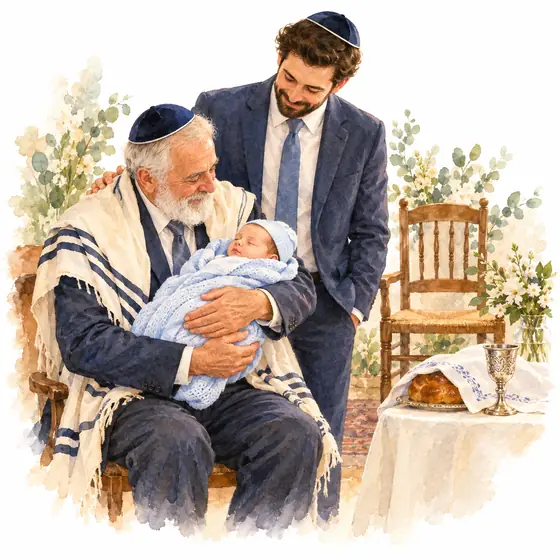

Someone is straightening a tiny outfit. Someone else is checking whether there are enough chairs. The grandparents are ready, the parents have barely slept, and the guest of honor has no idea how many people have come to meet him.
A brit milah brings together a very small baby and a very long family story. There are blessings, a name spoken aloud, and a table where relatives finally sit down together. To understand the day, it helps to begin with the word brit: a covenant.
A covenant that begins with Abraham
Brit milah is the Jewish covenant of circumcision, often called a bris in Ashkenazi pronunciation. Its biblical foundation is in Genesis 17, where God commands Abraham to circumcise himself and the males of his household, and instructs that future generations circumcise their sons on the eighth day. Leviticus 12:3 repeats the eighth-day commandment.
For families observing this mitzvah, or religious commandment, the ceremony expresses an enduring bond with God and with the generations who came before. A newborn cannot yet tell his own story. At the brit, his family speaks about the inheritance they hope to share with him.
The ceremony is not what makes a child Jewish. In traditional Jewish law, a boy born to a Jewish mother is Jewish from birth, even if his circumcision must be delayed.
Why the eighth day—and what if the baby is not ready?
The eighth day comes from the Torah’s instruction. Traditionally, the brit takes place during daylight, often in the morning. The birth date is included in the count; because Jewish dates change in the evening, parents should confirm the timing with the mohel rather than count the days themselves.
The baby’s health comes first. If he is unwell or there are medical concerns, the brit is postponed. His doctor and the mohel help establish when it is safe to proceed, with rabbinic guidance on the religious timing. A booked room or visiting relatives are never a reason to hurry.
An eighth-day brit can sometimes take place on Shabbat or a festival, but there are important conditions and exceptions. This is another detail to settle with the mohel before sending out the time.
How the family prepares
The first practical step is choosing a qualified, experienced mohel: the specialist trained to perform circumcision according to Jewish law. Parents should discuss the baby’s health, hygiene, pain relief, aftercare, and whom to contact afterward. Those conversations belong before the ceremony, when there is time to ask questions.
A brit may be held at home, in a synagogue, or in another suitable setting. The important considerations include a clean, properly prepared space, good lighting, and room for the mohel to work without a crowd pressing close. A quiet place for the mother and baby is a kindness worth planning.
Then come the family decisions: the boy’s Hebrew name, who will receive the ceremonial honors, and who will organize the meal. A relative who handles the chairs, food, and arriving guests gives the parents something valuable: a little less to carry.
Who takes part?
The mohel performs the circumcision. The sandek holds the baby during it, an honor often given to a grandfather, a rabbi, or another respected person close to the family.
In many Ashkenazi ceremonies, kvatters help bring the baby from his mother to the ceremony. This honor is often shared by a married couple. Other relatives may be asked to carry the baby at different moments or recite blessings. The exact arrangement varies; there is no need to invent a role for every cousin.
The father traditionally has particular blessings to say. The mother’s comfort and recovery matter throughout, whether she stays close to the ceremony or prefers a quieter spot nearby. A rabbi may help lead the gathering, but the rabbi and mohel are not necessarily the same person.
The special chair: welcoming Elijah
One of the most recognizable features of a traditional brit is the kiseh shel Eliyahu, the chair of Elijah. Jewish tradition describes the prophet Elijah as attending every brit, a witness to the continuing covenant.
This is a religious belief expressed through a physical place of honor. In some synagogues the chair is beautifully carved; elsewhere a simple chair is set aside for the occasion. The baby is traditionally placed briefly upon it as part of the ceremony.
The custom has a story behind it. Elijah told God that the Israelites had abandoned His covenant. Rabbinic tradition connects his presence at each brit with witnessing the Jewish people continuing to keep it. That little chair carries quite a conversation across the centuries.
What happens, and what is said?
As the baby arrives, guests may greet him with Baruch haba, a welcome. After the honors connected with Elijah’s chair, he is brought to the sandek. The mohel guides the family through the order used in their community.
The mohel recites the blessing for the commandment of circumcision, ending with al hamilah. The father traditionally recites a separate blessing about bringing his son into Abraham’s covenant, with the words lehachniso bivrito shel Avraham Avinu.
The gathering then voices a wish for the boy’s future: that his life will also include Torah, marriage, and good deeds. It is a striking moment. Everyone has gathered for the beginning of his life, yet their words already reach toward the person he might become.
Further blessings follow over a cup of wine, together with the prayer in which his Hebrew name is announced. A rabbi, the mohel, or another person given the honor may recite them. Wording and some details differ between communities. Parents can ask the mohel for their version beforehand; nobody needs to rely on a last-minute whisper.
And his name is…
For many families, this is the moment everyone has been waiting for. The parents have chosen the name; the person leading the naming prayer announces it. Sometimes half the room leans forward at once.
A name may remember someone deeply missed, honor a beloved relative, or express a hope the parents hold for their son. Ashkenazi families commonly name after relatives who have died and generally avoid naming after living relatives. Many Sephardic families gladly honor a living grandparent. Individual family customs deserve their own conversation.
The parents may explain the choice during the meal. A few personal sentences can make the name feel wonderfully alive: who carried it before, what that person loved, and what the family hopes to pass on. There are more family customs to explore in our story about Jewish birth and naming traditions.
After the ceremony, the celebration continues around the table. Explore the brit milah meal, its traditions, and four small recipes in our next story.
To remember this family milestone, choose a keepsake for a parent:
© Sarel Jewelry. All rights reserved. Please share this article by linking to the original page on sareljewelry.com. Copying or republishing our original text without prior written permission is prohibited, except as permitted by law.