

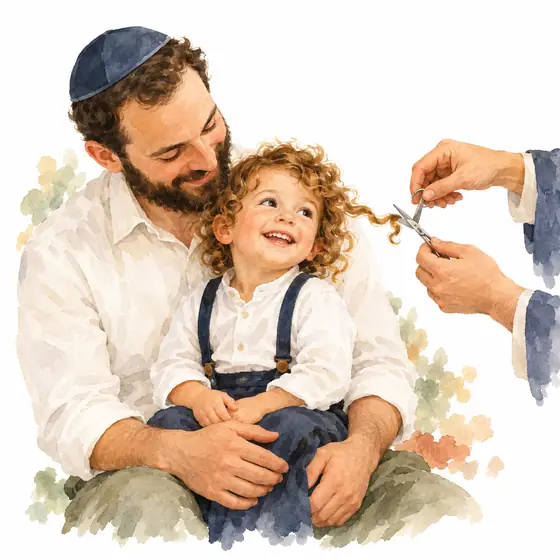
Three Years, One Little Haircut: The Jewish Chalakah Tradition

Three years of curls. A room full of proud relatives. And one little boy wondering why everyone is so interested in his hair.
A chalakah turns a first haircut into a family celebration—with learning, good wishes, and sometimes a very sweet first lesson.
What is a chalakah?
Chalakah, also called upsherin in Yiddish, is a boy’s first haircut ceremony, often held around his third birthday. Families who follow the custom usually leave his hair uncut until then.
It is practiced in many Hasidic and some Sephardic communities. Other Jewish families do not follow it.
Why wait until three?
One traditional explanation compares a growing child to a fruit tree. The Torah’s law of orlah sets aside a tree’s fruit during its first three years. The haircut draws on that image to mark a new stage of learning.
This is symbolism behind a custom, rather than a Torah rule requiring every boy’s hair to stay uncut until three. Explore the custom and its explanations.
A first lesson that tastes sweet
In some Ashkenazi Hasidic families, this stage also brings a celebration of beginning cheder, a traditional Jewish school. A father may carry his son there in the morning, wrapped in a tallit, or prayer shawl.
A teacher introduces Hebrew letters and Torah verses. The child tastes honey from an alphabet sheet and may eat honey cake bearing a passage of Torah. The message is deliciously simple: learning Torah should be sweet.
Chocolate letters can be a playful addition to a family celebration, too. The traditional honey-and-cake ceremony is a school-entry custom; it need not happen on the haircut day. Read about a Chabad school’s celebration.
From the family synagogue to Meron and Jerusalem
Some families celebrate at home or in a synagogue. Others travel to Meron, in northern Israel, near Rabbi Shimon bar Yochai’s resting place, particularly around Lag BaOmer.
In Jerusalem, families also celebrate at the Kotel, the Western Wall. The Western Wall Heritage Foundation describes these ceremonies throughout the year.
Timing varies. Chabad families generally mark the third Jewish birthday itself, subject to days when haircuts are postponed. Some Sephardic traditions use a later age. There is no single timetable for every community. This guide discusses the differences.
A snip, a kippah, and a new beginning
A rabbi or honored relative may cut the first lock, with others taking a turn. A barber can finish the haircut afterward. The hair at the sides of the head—the peyot—is treated according to the family’s religious practice.
In many observant families, this milestone also marks more regular wearing of a kippah and tzitzit, the ritual fringes on a four-cornered garment. Some boys have already begun wearing them.
And what happens to the curls?
One practice described in Chabad guides is to collect and bury the cut hair respectfully. Another links its weight with a donation to charity. The boy may also put money into a charity box himself—a small action with a big message. Read more about these customs.
A family keepsake to put away for the years ahead:
© Sarel Jewelry. All rights reserved. Please share this article by linking to the original page on sareljewelry.com. Copying or republishing our original text without prior written permission is prohibited, except as permitted by law.