

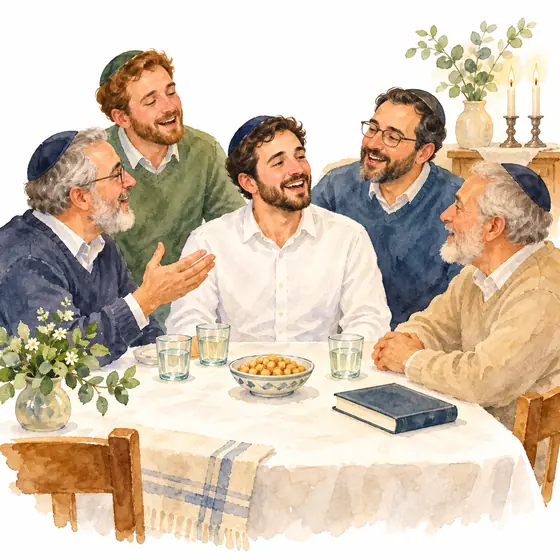
A Little Welcome: Shalom Zachar and a Baby Boy’s First Shabbat

A new baby has arrived. The grown-ups have plenty to say. The guest of honor may sleep through every word.
In many Ashkenazi families, his first Friday night brings a shalom zachar: a gentle gathering of good wishes, Torah, songs, and something to nibble.
A welcome after Friday-night dinner
Friends, relatives, and neighbors usually gather after the Shabbat evening meal. It is often a visit with light refreshments rather than another full dinner. People congratulate the father, share words of Torah, and sing.
The gathering can take place even while mother and baby are still in hospital. Their presence is not what makes the welcome meaningful. Aish’s guide describes this early celebration.
Shalom zachar is a community custom, not a ceremony every Jewish family observes. It is also separate from the brit milah.
Why are there chickpeas on the table?
A bowl of chickpeas may seem a modest way to welcome someone so important. But these little beans carry a story.
One traditional explanation draws on the Talmudic teaching that a baby learns Torah before birth and forgets it on entering the world. Guests offer comfort for that forgotten learning, alongside their joy at his arrival.
Round legumes, also associated with mourning and the cycle of life, give that idea a place at the table. Chickpeas are common; lentils appear in explanations of the custom, too. They are meaningful traditional foods, rather than a compulsory menu for every family. Read about the symbolism of the refreshments.
Ashkenazi families: a Friday-night tradition
Shalom zachar is especially associated with Ashkenazi communities. The first Friday evening after birth is the usual time, although practices can differ when a brit is delayed.
Another gathering, sometimes called a vach nacht, belongs to the night before the brit. The two occasions have different places in the calendar. Torat Har Etzion explores the Friday-night custom.
Moroccan families: evenings of prayer and song
Moroccan Jewish traditions include gatherings before the brit with sacred readings, songs, and food. A rabbinic account describes Brit Yitzchak on the preceding evening.
Historical accounts also describe tahdid, a protective folk ritual involving a sword and prayers during the nights before circumcision. This reflects beliefs and practices of particular communities; it is not a universal Jewish requirement or a description of every Moroccan home today. Read an account of Moroccan brit customs.
Bukharian families: a welcome in song
Bukharian Jewish traditions have their own musical language for a new arrival. Researcher Elena Reikher documents songs and a festive gathering associated with the brit milah.
Some Bukharian women also celebrate gahvorabandon, placing a newborn into a special cradle, with singing. These are distinct celebrations, rather than simply another name for shalom zachar. Explore Reikher’s research and the Jewish Language Project’s cradle-ceremony description.
Mountain Jewish families: gathering around the brit
Ethnographer M. K. Musaeva’s study of Mountain Jews in Dagestan describes historical practices of keeping vigil before the brit, followed by a celebratory meal after it.
These accounts belong to a particular region and period. They do not establish a standard Mountain Jewish Friday-night shalom zachar. The community’s own customs deserve their own names and stories. Read the ethnographic study.
The best thing a guest can bring
Ask the family when to come and what would help. A short, warm visit can be plenty. So can offering to tidy up.
Different homes have different songs, dishes, and schedules. There is one welcome addition to almost any gathering: someone who notices the parents could use a hand.
For the next chapters, explore Jewish birth and naming traditions and pidyon haben.
A little gift for the new mother or father:
© Sarel Jewelry. All rights reserved. Please share this article by linking to the original page on sareljewelry.com. Copying or republishing our original text without prior written permission is prohibited, except as permitted by law.