

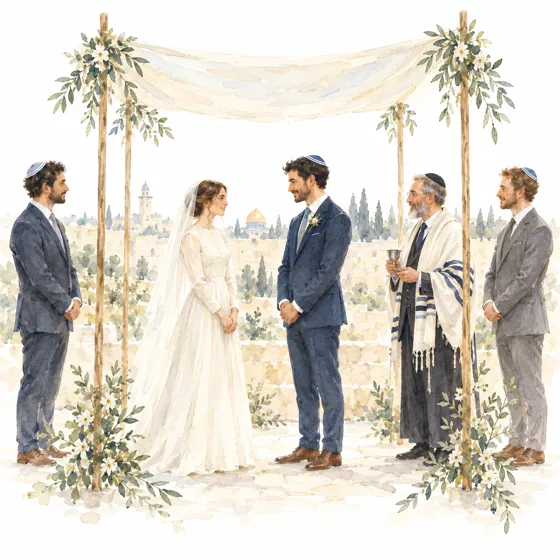

The guests grow quiet. Under the chuppah (חופה, wedding canopy), a cup of wine and a small ring are waiting. The family has already celebrated an engagement; this moment has another purpose. The couple are entering a marriage.
To understand what is happening, it helps to untangle two words that sometimes cause confusion: erusin (אירוסין, betrothal; in modern Hebrew, engagement) and kiddushin (קידושין, literally “sanctification,” the binding first stage of Jewish marriage).
One word, two meanings
In everyday modern Hebrew, erusin can mean engagement: the period when a couple are preparing to marry. A family might use it for their engagement gathering, with congratulations, gifts, and perhaps tena’im (תנאים, literally “conditions,” the marriage agreements between the families).
In classical Jewish law, erusin is another name for kiddushin, the first binding stage of marriage. Historically, it could take place well before the second stage, nisu’in (נישואין, marriage; here, the stage that completes the marriage). Today the two are generally brought together in one wedding ceremony.
That is why a family engagement and the act under the chuppah should be explained separately, even when the same word appears in both conversations.
What happens at kiddushin?
In a traditional Orthodox ceremony, blessings over wine introduce the betrothal. The groom then gives the bride a ring before two qualified witnesses, making the traditional declaration that she is consecrated to him according to Jewish law. She knowingly accepts it.
The ring is usually a simple band. The officiating rabbi checks that it meets the ceremony’s requirements and helps the couple understand the act. It is a legal and religious commitment, rather than simply a wedding-day present.
Once valid kiddushin has taken place, ending the relationship requires a religious bill of divorce, a get (גט), even if the second stage of marriage has not yet followed. This is a crucial difference from an ordinary engagement.
What comes next?
The ketubah (כתובה, marriage contract setting out obligations) is commonly read between the two stages. The ceremony proceeds to nisu’in, with the seven wedding blessings, or sheva brachot (שבע ברכות, “seven blessings”). The rabbi guides the details according to the community’s practice.
The broken glass near the ceremony’s end is a separate custom from the plate sometimes broken at tena’im. A guest can enjoy both family traditions without confusing either vessel with the act of kiddushin.
Ashkenazi and Sephardic settings
The basic traditional distinction between kiddushin and nisu’in is shared, while the surrounding customs vary. In many Ashkenazi weddings, the bride circles the groom on arriving at the chuppah. Sephardic practice generally omits this circling.
Afterward, many Ashkenazi couples spend time together in a private room, called yichud (ייחוד, seclusion or private time together), before the reception. Many Sephardic authorities place that privacy later, after the festivities. Families combining traditions can discuss the sequence with their officiating rabbi in advance.
These differences are part of how communities understand and arrange the wedding. They are more than changes of music or decoration, and they do not turn every wedding into a completely different rite.
How do egalitarian ceremonies differ?
Many Reform ceremonies make the commitments mutual, with both partners giving rings and speaking declarations. The wording, witnesses, and ceremony are shaped by the movement and officiant. These choices express an egalitarian understanding of marriage.
For a couple preparing their own wedding, the useful question is specific: what ceremony will our rabbi conduct, and what does each part mean? Understanding those answers is more helpful than assuming all Jewish weddings follow exactly the same rules.
A wedding gift with a personal meaning
A royal-blue Menorah necklace or a blue enamel Star of David with garnet can be a personal keepsake for someone who loves Jewish symbols. The bride may choose a Magen David (מגן דוד, “Shield of David,” commonly called the Star of David) for her groom, or relatives may choose a gift for the couple according to their tastes.
Such gifts are separate from the ring used for kiddushin. What gives the ceremony its weight is the commitment the couple understand and accept, witnessed by the people gathered around them.
© Sarel Jewelry. All rights reserved. Please share this article by linking to the original page on sareljewelry.com. Copying or republishing our original text without prior written permission is prohibited, except as permitted by law.