

Two Families, One Happy Table: Vort, Tena’im and Jewish Engagement

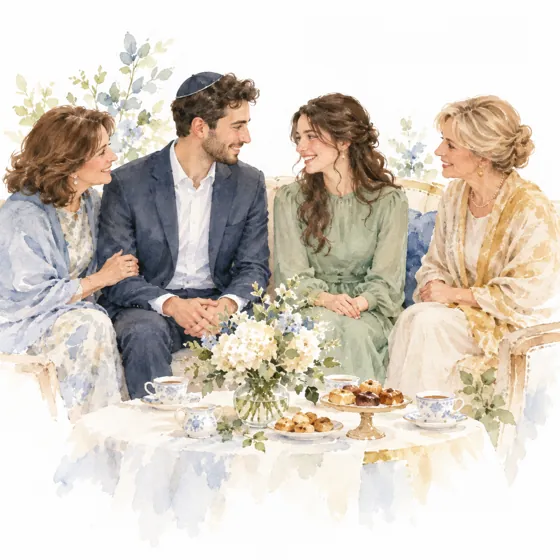
The couple have shared their news. Now the parents are meeting, someone is making tea, and the conversation moves between congratulations and practical questions. When shall we gather? Which customs matter to each family? Who is bringing the cake?
From the announcement to the family gathering
In one familiar sequence, the couple decide to marry, tell their parents, and bring the two families together. Discussions about the engagement gathering lead into wedding preparations: a possible date, expenses, guests, and the traditions each side hopes to share.
Some families have been involved from the first introduction. Others meet only after a proposal. Either way, leave room for the couple’s wishes as well as family memories.
In everyday Hebrew this engagement may be called erusin. The term also has a different, technical meaning in Jewish marriage law. Here we are describing the family celebration before the wedding.
Ashkenazi customs: a vort and a broken plate
In many Ashkenazi Orthodox families, the engagement gathering is called a vort, Yiddish for “word”: the couple have given their word. Relatives come to congratulate them, share refreshments, and welcome the new connection between their families.
Some gatherings include tena’im, meaning “conditions.” These can record the wedding date and place, financial responsibilities, and commitments to help establish the new home. Traditional forms can include guarantors and consequences for breaking the agreement. The document is distinct from the ketubah used at the wedding.
Where this practice is followed, a rabbi guides the agreement, witnesses, and kinyan, the formal act of accepting the commitments. The families should understand the text before signing it.
Why do the two mothers break a plate?
For a moment, both mothers hold the wrapped ceramic plate. There is a crack, and then the congratulations begin again. Their shared participation makes it an especially moving family moment. If a mother is absent, another woman may share the honor according to the family’s practice.
The plate belongs to an established Ashkenazi custom associated with tena’im. It is recorded in Eliyah Rabbah, Orach Chayim 560:7, citing the earlier Malbushei Yom Tov, and is discussed in Mishnah Berurah 560:9. These are references in rabbinic writings, rather than a commandment in the Torah to break a plate.
One explanation is remembrance of the destroyed Temple in Jerusalem, keeping even a joyful gathering connected to Jewish memory. Another sees the broken vessel as a reminder to take promises seriously. Those meanings explain the custom; they do not mean that a couple must proceed with an unsuitable marriage.
These sources record a custom; they do not establish the first occasion when two mothers performed it. Breaking the plate is not required at every Jewish engagement.
In Chabad families: a l’chaim
Chabad families often call the gathering a l’chaim, “to life.” A toast, a Hasidic melody, and words of Torah give the celebration its character. The groom may share a Hasidic teaching. These details belong to a particular tradition; guests do not need to know the songs to join the happiness.
Sephardic traditions: more than one way to celebrate
Some Sephardic communities use the name “kinyan ceremony” for the engagement gathering. Written agreements also vary: a Moroccan Jewish tradition places wedding commitments in the ketubah, the marriage document, rather than a separate engagement contract.
Ask the family what they call the occasion, which blessings or songs they remember, and who traditionally takes part. A shared Sephardic identity does not mean every family uses the same agreement or breaks a plate.
Some families also hold a separate henna celebration before the wedding. It has its own place in the festivities and is not another name for every engagement party.
A simple plan for the gathering
Start by asking both families which customs matter to them. If there will be tena’im or a kinyan, arrange rabbinic guidance beforehand: some communities leave the written tena’im until the wedding day.
Then choose a comfortable place and a menu that suits the guests’ dietary needs. Tea, pastries, and fruit can make a lovely table; a full meal is another option. There is no single engagement dish that every Jewish family must serve.
Leave time for the couple to speak, for a short teaching or family blessing, and for the people who have just met to talk. A grandmother’s remembered song may bring more warmth than an elaborate program.
A keepsake for a new beginning
A personal gift can mark the day without becoming part of the ceremony. Consider a tiny blue Hamsa with a Star of David or a mint enamel Star of David with garnet. Choose something that feels like the person receiving it, and add a note about the beginning you are celebrating.
There will be plenty to arrange after the guests go home. For this evening, make room to enjoy the news together.
© Sarel Jewelry. All rights reserved. Please share this article by linking to the original page on sareljewelry.com. Copying or republishing our original text without prior written permission is prohibited, except as permitted by law.