

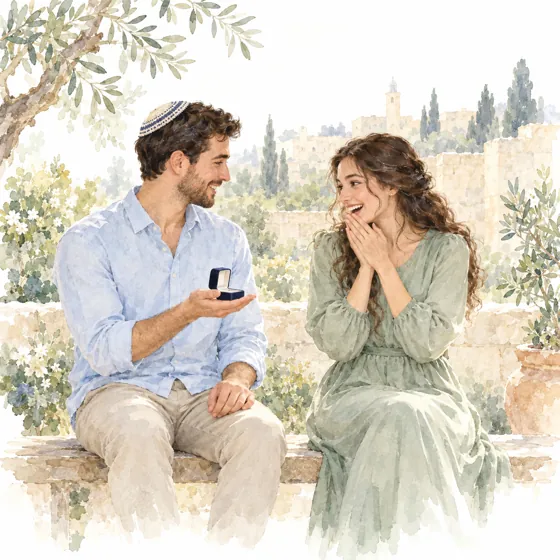
Will You Marry Me? A Jewish Proposal and the Beginning of a Shared Life

The question may come on a walk, across a small table, or after a conversation that has been growing for weeks. There may be a carefully chosen ring. There may simply be two people who have reached the same hopeful answer.
A proposal turns the thought of a shared future into something they can say aloud. In Hebrew it is called hatza’at nisuin, a proposal of marriage.
When does the proposal happen?
There is no single Jewish timetable. A couple who met through a shidduch may have spoken seriously about marriage from their first meetings. For another couple, those conversations develop gradually. Either way, a thoughtful proposal grows from knowing what they are agreeing to.
The setting can still be a lovely surprise. The wish to marry, and the freedom to say yes or ask for more time, deserve an honest conversation.
A quiet decision or a planned surprise
In some Orthodox families, the decision emerges through conversations between the couple, with a matchmaker helping communicate their wishes. There may be no separate moment of kneeling and opening a ring box.
Other Jewish couples choose a private proposal, a family occasion, or a celebration with friends. A seaside photograph or a restaurant reservation belongs to personal taste. Neither Ashkenazi nor Sephardic heritage supplies one proposal scene that every couple must recreate.
If one person dislikes an audience, a quiet moment may mean more than a room full of applause. The most memorable detail can be a sentence that sounds entirely like the person saying it.
What does the ring mean?
In families where an engagement ring is given, it can be the visible sign of a new social status: she is now a bride-to-be, and the pair are engaged. Some choose the ring together; others prefer a surprise. The symbol expresses their commitment to one another.
This is different from the ring used for kiddushin, the religious act usually performed at the wedding. An ordinary engagement gift does not by itself normally establish a Jewish marriage. Couples who observe religious law should discuss the giving of a ring with their rabbi, since words, intention, and witnesses can matter.
Chabad practice generally leaves the diamond engagement ring until after the chuppah. That custom is a useful reminder that a couple can be wholeheartedly engaged without following the familiar ring-box scene.
Telling the parents
For many families, the next step is to tell the parents on both sides. The families arrange to meet, offer their good wishes, and begin discussing what comes next. In other homes, parents have already been involved during the introductions.
The first conversation can stay warm and simple. Later there will be practical questions: the engagement gathering, a possible wedding date, the guest list, the budget, and which family traditions the couple want to keep.
This is where preparation for a family engagement celebration can begin. The gathering itself has its own customs and deserves a story of its own.
A heart, a Chai, a gift for him
A ring is not the only way to give the day a keepsake. A heart necklace with garnet can carry a personal message of love. A small lilac Star of David with Chai brings the Hebrew word for “life” into a gift for the life they hope to build.
The bride-to-be may also choose something for her fiancé, such as an openwork Star of David with Chai. These are personal gift ideas, rather than prescribed parts of the proposal. Families following particular gift customs can choose the right timing together.
Whatever they exchange, the beginning belongs to both of them: a decision made freely, and a future they are ready to start planning.
© Sarel Jewelry. All rights reserved. Please share this article by linking to the original page on sareljewelry.com. Copying or republishing our original text without prior written permission is prohibited, except as permitted by law.