

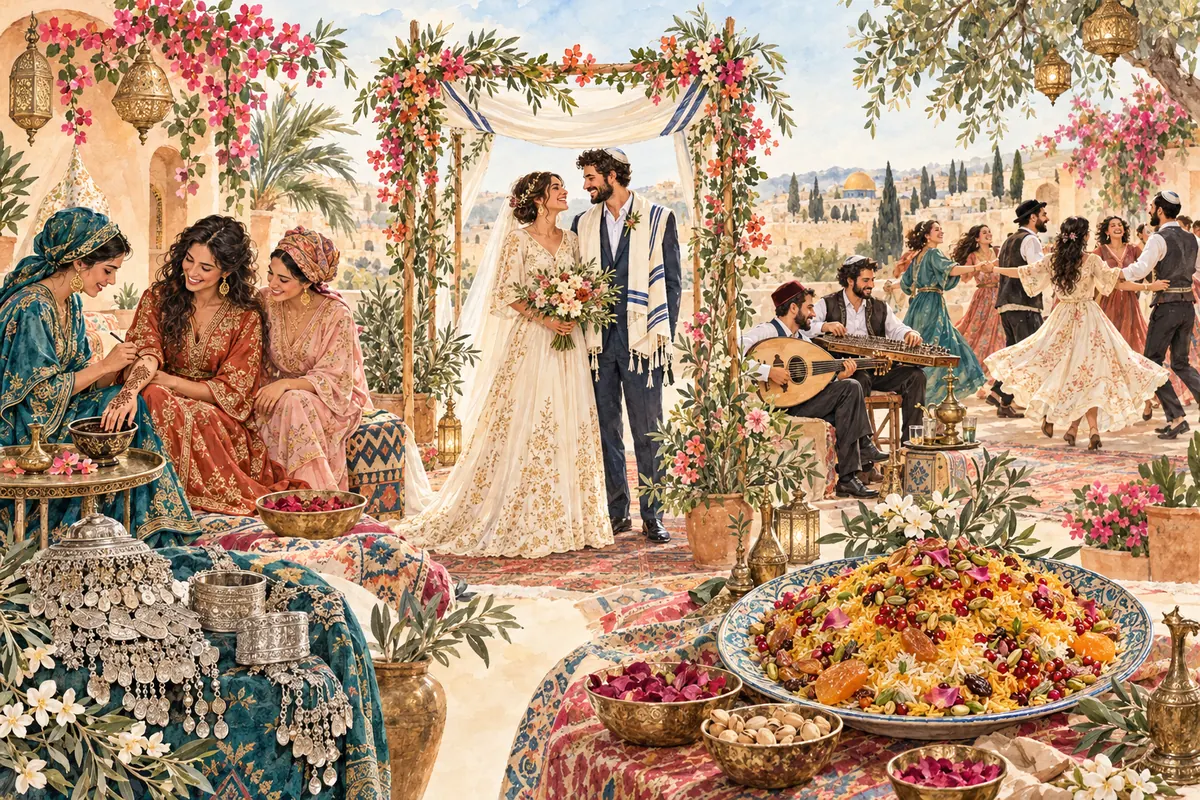

Jewish wedding traditions have a lot in common. But the party? That depends on the family! There may be henna, special songs, bright clothes, or a dance floor that refuses to close.
Let’s visit a few celebrations, from Moroccan and Yemenite families to Persian homes, America, and Israel. Bring your curiosity. And perhaps some comfortable shoes.
One wedding, many family roots
First, a quick note. Moroccan, Yemenite, and Persian describe family roots. Israeli and American tell us where people live. So a wedding in Israel or America can include any of these traditions.
Also, no two families celebrate in quite the same way. These are a few customs you might see, rather than rules for every wedding.
Moroccan Jewish wedding traditions: start the party early
Why wait for the wedding to celebrate? In some Moroccan Jewish families, a henna party brings loved ones together before the big day.
There may be bright outfits, music, and a table full of sweets. Henna is placed on the couple’s palms, with wishes for a happy life together.
The bride may wear a rich traditional dress. Cookies add another sweet touch: they express a wish for sweetness in married life. You can explore these customs in UCLA’s guide to Moroccan and Persian Jewish celebrations.
A party before the party? We can see the appeal.
Yemenite weddings: jewelry with a story
Next, take a closer look at the bridal jewelry. Traditional bridal dress from Yemen can be full of beautiful details.
Historic brides in Sana’a wore many pieces of jewelry in a set order. Israel Post’s Jewish jewelry brochure describes this rich bridal style. Each piece was part of a larger look.
Some Yemenite families also hold a henna celebration. However, their customs differ from Moroccan ones. This guide to Jewish henna traditions explains how the custom appears in several communities.
Today, a bride might choose a traditional outfit or just one detail from her family’s past. Either way, it can be a lovely link between generations.
Persian weddings: follow the music
Meanwhile, Persian Jewish wedding traditions offer plenty for the ears and the taste buds.
UCLA’s guide introduces “Shah Dumad,” a Persian wedding song. It also describes older customs in which families held several events before the wedding.
Then there is the food. Morasa polo, often called jeweled rice, can bring together saffron, fruit, and nuts. Familiar songs and family dishes help carry memories into a new celebration.
Jeweled rice sounds almost too pretty to eat. Almost.
In America: make room for the hora
At many American Jewish weddings, the hora brings guests onto the dance floor. The couple may even be lifted on chairs. This firsthand guide to the hora gives a taste of the fun.
So, your next polite chat may have to wait until after the dancing.
Of course, there is no single American Jewish wedding style. A Persian family in California may celebrate differently from an Ashkenazi family in New York. Each couple brings their own mix.
In Israel: when traditions meet
What happens when families with different roots plan a wedding together? They have a lot to choose from.
For example, a couple might choose a henna evening from one family and favorite songs from the other. Or they might keep the day simple. Family roots, personal taste, and religious practice all play a part.
That is the joy of Jewish wedding traditions: they can travel across the world and still feel like home.
A small reminder of a big day
Once the music stops, little things bring the day back. A photo. A song. A piece of jewelry worn for the occasion.
For someone who loves jewelry, a meaningful piece can become a keepsake. Our wedding jewelry selection is one place to look. Start with the person and what they love.
Which tradition would you bring to your own celebration?
Customs vary between families and communities. This article shares cultural highlights, rather than religious instructions.
A little keepsake of a day worth remembering:
© Sarel Jewelry. All rights reserved. Please share this article by linking to the original page on sareljewelry.com. Copying or republishing our original text without prior written permission is prohibited, except as permitted by law.